
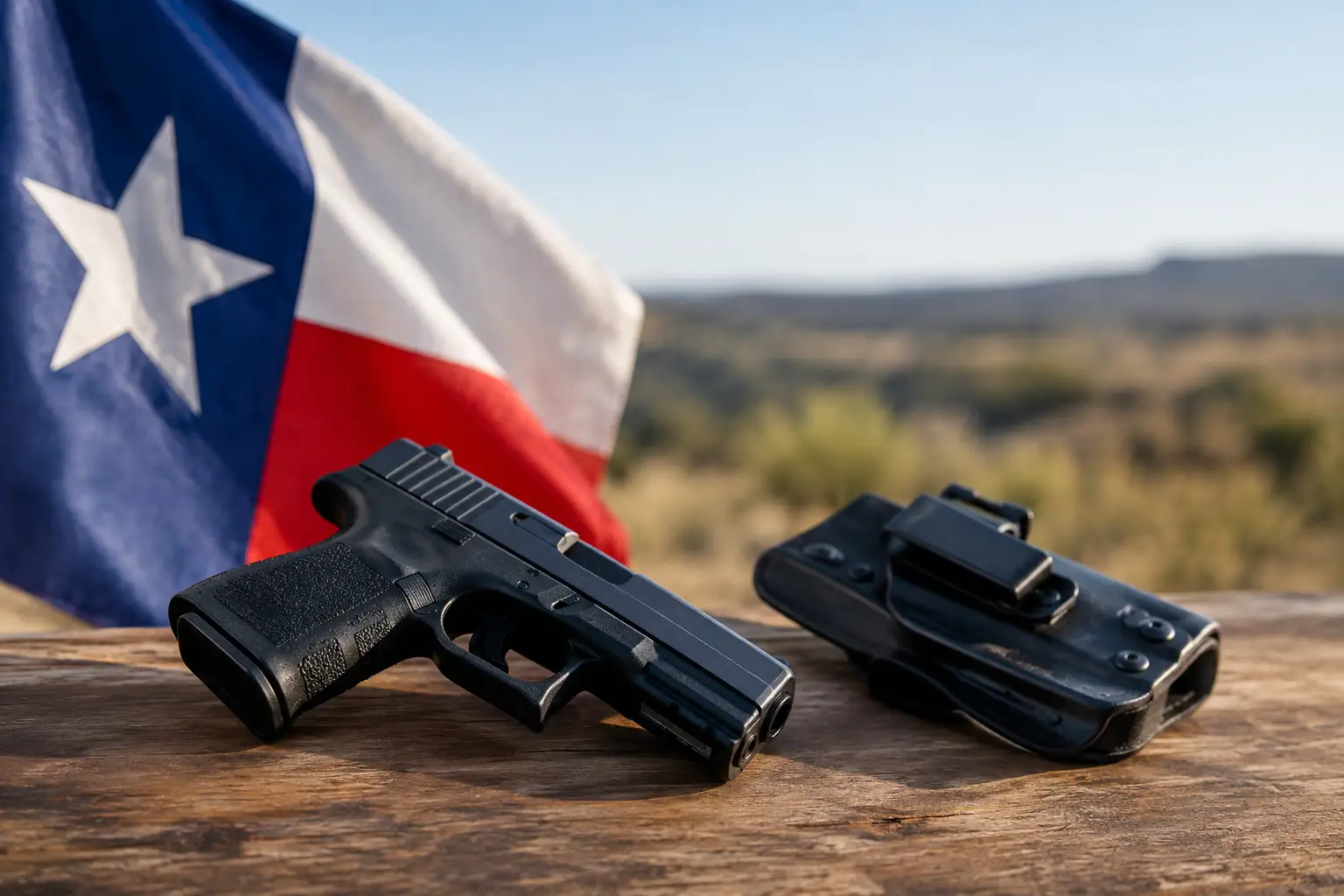
A person can legally carry a handgun without a license and still have never taken a firearms class. That is the short answer to the question, does constitutional carry require training in Texas? For most people who qualify to carry without a license, Texas does not require a classroom course, a shooting test, or a state-issued License to Carry before they carry a handgun in public.
That does not mean training is optional in the practical sense. Carrying a firearm safely means understanding where you may carry, when you may use force, how to handle a handgun under stress, and how to avoid a simple mistake that can become a serious legal problem. A law may not require a course, but responsible carry requires preparation.
Does constitutional carry require training in Texas?
No. Texas permitless carry, often called constitutional carry, does not generally require a person to complete firearms training before carrying a handgun without a License to Carry. A qualified person may carry a handgun without first taking the Texas LTC classroom instruction or passing the state proficiency demonstration.
Texas law still has eligibility requirements. You must be legally allowed to possess a firearm, and other criminal history or legal restrictions can affect whether you may carry. Age requirements and eligibility rules can also change through legislation and court decisions. Do not assume that permitless carry applies to you simply because you own a handgun.
The basic rule is straightforward: no training certificate is required for permitless carry. The details are not always straightforward, especially when you are deciding whether you can carry in a particular building, business, vehicle, or public event.
A License to Carry still requires training
Constitutional carry did not eliminate the Texas License to Carry. It created another legal option for eligible Texans. If you choose to apply for an LTC, training is still part of the process.
The Texas LTC course covers the state-required subjects, including firearm safety, safe storage, nonviolent dispute resolution, use-of-force laws, and laws that apply to carrying a handgun. Applicants also complete the required proficiency demonstration at a range. This gives an instructor the opportunity to watch basic gun handling, correct unsafe habits, and help the student become more comfortable operating their firearm.
For many first-time gun owners, that hands-on portion is where the learning becomes real. Loading a magazine, finding the sights, managing recoil, keeping a finger off the trigger, and safely holstering a firearm are simple skills only after they have been practiced correctly.
An LTC is not automatically necessary just because you want to carry a handgun in Texas. But it can still be useful. It provides a recognized credential and may offer benefits in certain interstate travel situations, depending on the laws of the state you visit. Before crossing state lines with a firearm, check that state’s current laws. Texas carry rules do not travel with you.
Why no required training does not mean no need for training
A handgun is not like a wallet or a phone. It is a tool that demands safe handling every time it is loaded, stored, carried, drawn, or cleaned. Carrying it in public adds more variables: crowds, children, vehicles, unfamiliar locations, arguments, and the pressure of making decisions quickly.
Quality instruction helps you build habits before you need them. A good beginner lesson should cover safe handling from the ground up, not assume you already know what to do. It should also give you time to ask questions without feeling rushed or embarrassed.
Training is especially valuable in four areas:
- Safe gun handling: Learn how to load, unload, clear, and store your handgun while following the core firearm safety rules.
- Shooting fundamentals: Build a stable grip, proper sight alignment, trigger control, and recoil management so you can make accurate hits.
- Carry skills: Practice choosing and using a safe holster, drawing only when appropriate, and reholstering carefully.
- Legal awareness: Understand prohibited places, posted notice requirements, interactions with law enforcement, and the limits on use of force.
The goal is not to turn every new shooter into a competitive marksman. The goal is to help a responsible adult handle a firearm safely and make better decisions.
Where constitutional carry is restricted
Permitless carry is not permission to carry everywhere. Texas has locations where firearms are prohibited by law, and private property owners can restrict firearms on their property through legally effective notice.
Examples can include schools, courtrooms, polling places, secured areas of airports, certain government meetings, and businesses or properties that provide proper notice under Texas law. Some places have separate rules for licensed carry and unlicensed carry. A location may also have security screening or policies that create additional concerns.
This is one reason an LTC course remains valuable even for someone who plans to carry without a license. The most common carry mistake is not necessarily unsafe shooting. It can be walking into a restricted place because someone assumed, “Constitutional carry means I can carry anywhere.” It does not.
Pay attention to posted signs before entering private businesses. If an owner or someone with authority tells you firearms are not allowed, take that direction seriously. Carry laws are specific, and the consequences of ignoring a restriction can be much more serious than an inconvenience.
Carrying in your vehicle is different from carrying everywhere else
Texas has long allowed many people to keep a handgun in a vehicle or watercraft under certain conditions. That does not erase the rules for carrying after you step out of the vehicle.
A handgun carried on or about your person must be handled and secured responsibly. If you carry openly, use a proper holster. If you carry concealed, choose a holster that keeps the trigger covered and holds the handgun in place during normal movement. Tossing a loaded handgun into a glove box, center console, purse, or waistband without a safe carry method creates avoidable risk.
Vehicle carry also requires planning. Think about what happens when you arrive at a location where firearms are prohibited. Leaving a firearm unsecured in a vehicle can invite theft and put a stolen gun into criminal hands. A secure lockbox and a consistent routine are far better than making decisions in a parking lot.
The legal standard is not just whether you felt threatened
People often focus on the question of whether they can carry. The more important question is whether they understand when they may use a firearm. Carrying a handgun does not give anyone authority to threaten, intimidate, or settle an argument with force.
Texas self-defense law is fact-specific. The circumstances, your actions leading up to the incident, what you reasonably perceived, whether you had a lawful right to be present, and whether force was immediately necessary can all matter. A situation can unfold in seconds and still be examined for months in court.
The best outcome is usually avoiding the confrontation altogether. Distance, awareness, a calm response, and leaving when you safely can are practical skills. Responsible armed citizens do not look for reasons to use force. They work to avoid situations where force might become necessary.
Should beginners take training before carrying?
Yes. If you are new to handguns, take training before you carry in public, even though Texas constitutional carry does not require it. Start with a beginner-friendly lesson if you have never fired a gun or are not yet comfortable handling one. Then consider the Texas LTC course if you want the state-approved instruction and range qualification experience.
At The Burns Group, students can complete the classroom portion of the Texas LTC course online and receive in-person review, shooting instruction, and the required proficiency demonstration at an indoor range in Humble. That format works well for busy adults and for beginners who want direct help before stepping onto the firing line.
Do not wait until you feel completely confident to get instruction. Confidence should come from correct repetition, not from guessing. Learn the law, practice the fundamentals, use secure equipment, and keep training after the class is over. Texas may not require training for constitutional carry, but the people around you deserve the care and judgment that training helps build.
Leave a Reply