
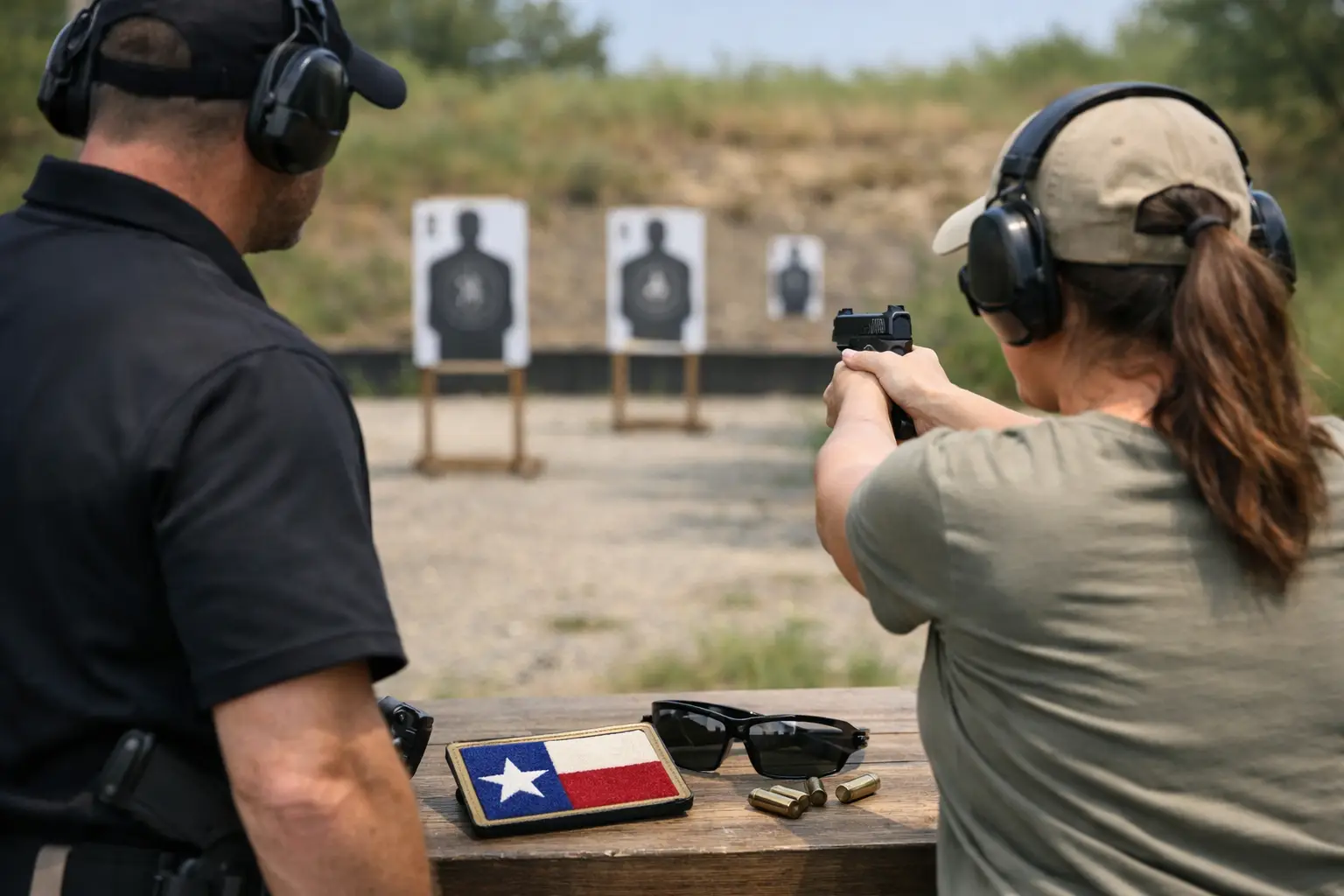
If the shooting portion is the part making you hesitate, you are not alone. For many students, the texas ltc range qualification is the only part of the process that feels intimidating. The good news is that it is straightforward, controlled, and very manageable when you know what to expect. Wally teaches you in a fun, stress free environment. Once Wally teaches you the basics, things become easy.
A lot of people show up assuming the range test is built for experienced shooters. It is not. The proficiency demonstration is designed to confirm safe gun handling and basic accuracy, not to turn you into a competitive marksman. If you are a first-time shooter, that matters. It means preparation, coaching, and calm instruction usually matter more than raw experience.
What the Texas LTC range qualification actually is
The range qualification is the live-fire portion required for a Texas License to Carry course. After completing the classroom or online instruction with a state-approved provider, students must complete a shooting proficiency demonstration with a qualified instructor.
This is not an advanced tactical course. You are not moving, shooting from cover, or working through complicated drills. You will shoot a set course of fire at standard distances while an instructor evaluates your score and safe handling. The process is structured, and the expectations are clear.
For most students, that clarity is a relief. The range portion is meant to be passable for ordinary adults who are willing to listen, follow directions, and apply basic fundamentals.
Texas LTC range qualification course of fire
The Texas LTC range qualification uses 50 rounds fired at a B-27 silhouette target. The course is divided into three distances: 3 yards, 7 yards, and 15 yards. Those distances sound more serious on paper than they feel on the firing line, especially with an instructor walking you through the process.
At 3 yards, students fire 20 rounds. At 7 yards, students fire 20 rounds. At 15 yards, students fire 10 rounds. Each stage includes specific strings of fire, and your instructor will explain the commands before you begin. You do not have to memorize every sequence ahead of time.
What matters most is that you listen carefully and handle the firearm safely. Most scoring problems come from rushing, jerking the trigger, or getting flustered. Those issues can usually be reduced with a short coaching session before the qualification starts.
How the scoring works
The target is scored on a point system for a maximum of 250 points. To pass, you need a score of 175 or higher. That means you do not need a perfect target. You do not even need to be close to perfect.
This is where many nervous students relax. The passing standard leaves room for less-than-perfect shots as long as you are keeping rounds in the higher-value zones often enough. A student who shoots carefully and follows simple marksmanship basics can usually meet the standard without trouble.
It also helps to remember what the test is measuring. The state is looking for baseline proficiency. It is not expecting tiny groups or expert-level speed.
What to bring to your LTC proficiency demonstration
Most students need a handgun, 50 rounds of ammunition, eye protection, and ear protection. In some cases, Wally will furnish a handgun for your test, but you should always confirm the details before your appointment.
You should also bring a handgun that you can safely operate and control. A larger-caliber pistol does not earn extra credit. In fact, many beginners shoot better with a manageable firearm such as a .22 that has less recoil. If your goal is to pass the texas ltc range qualification, comfort and control matter more than impressiveness.
Wear practical clothing. Closed-toe shoes are the smart choice. Avoid anything too loose or distracting at the firing line. If you wear a brimmed hat, that can also make range time more comfortable.
Does the gun type matter?
For most modern LTC students, the bigger issue is not caliber classification but whether the firearm is safe, functional, and suitable for the shooter. A reliable handgun you can operate confidently is the better choice over something unfamiliar or uncomfortable.
If you are borrowing a gun from a friend or family member, make sure you know how it works before qualification day. That includes loading, unloading, using the safety if applicable, and locking the slide open if required. The less mystery there is, the smoother the session will go.
Can a beginner pass the Texas LTC range qualification?
Yes. Beginners pass every week.
The students who struggle most are usually not the ones with the least experience. They are the ones who arrive tense, embarrassed to ask questions, or determined to muscle through without coaching. A beginner who listens and stays teachable often does better than someone who has years of casual shooting habits but poor fundamentals.
A short lesson from Wally Burns before the qualification can make a real difference. Grip, stance, sight alignment, and trigger press are not complicated, but small corrections can clean up your shooting fast. If you have never fired a handgun before, a patient instructor can take a lot of the uncertainty out of the process.
That is especially important for students around Humble, Kingwood and the northeast Houston area who want a local option instead of navigating a crowded, impersonal process. A beginner-friendly approach can turn what feels stressful into something clear and manageable.
Common mistakes during Texas LTC range qualification
Most problems on qualification day are predictable. Students rush the shot because they think they need to shoot faster than they actually do. They anticipate recoil and push the gun downward. Or they focus so much on the target that they stop paying attention to the front sight and trigger press.
Another common mistake is showing up with the wrong gear or unfamiliar equipment. If the magazine is unreliable, the ammunition is incorrect, or the shooter barely knows how the handgun operates, unnecessary stress gets added to a simple course.
There is also a mental side to it. Some students throw away easy points after one bad shot because they assume they are already failing. They are usually wrong. Since the passing score allows room for mistakes, a single poor string does not ruin the qualification. Staying calm matters.
How to improve your odds before range day
If you have time to prepare, even one basic practice session with Wally Burns can help. Focus on safety, consistent grip, and a smooth trigger press. You do not need a complicated training plan.
Dry practice with an unloaded firearm can also help if done safely and correctly. It allows you to work on sight picture and trigger control without recoil. For many new shooters, that is where confidence starts.
If you want the fastest path to improvement, get coached before you qualify. Wally Burns offers 30 minute and 1 hour shooting lessons. Personalized instruction usually fixes problems much quicker than guessing on your own.
What happens after you pass
Once you complete the classroom requirement and pass the shooting proficiency demonstration, your instructor provides the documentation needed for your LTC application process. From there, the state handles the remaining licensing steps.
That is why accuracy and recordkeeping matter on qualification day. A legitimate, state-approved process is not just about getting rounds on paper. It is about making sure your training is completed correctly so you can move forward without delays.
For students who already finished the classroom portion elsewhere, a standalone qualification session may be the simplest option. For others, an online class plus in-person review and range work is often the most convenient route. It depends on where you are starting and how much instruction you need.
Choosing the right help for Texas LTC range qualification
Not every student needs the same level of support. An experienced shooter may just need an efficient, professional qualification appointment. A brand-new gun owner may need extra time, a short lesson, and reassurance before firing the first round.
That is why the best training environment is one that does not treat every student the same. A good instructor keeps the process organized, explains the standards clearly, and helps you correct mistakes without making the experience harder than it needs to be. If you are looking for that kind of local, hands-on instruction near Humble, The Burns Group is built around exactly that approach.
The texas ltc range qualification should feel like a step forward, not a hurdle that stops you. If you come prepared, ask questions, and work with Wally who knows how to teach beginners, there is every reason to expect a solid, confident day on the range.
Leave a Reply